- Introduction and Overview of
Usability Challenges
After a brief preview of the entire tutorial, we will consider in
turn a number of general usability challenges that arise with systems
based on semantic technologies. For example, with reference to the
e-culture prototype we will discuss the general challenge of allowing
users who query or browse a semantically based system to take
advantage of the ontology that underlies the system without being
exposed to most of its details or dealing with it in an abstract way.
With respect to the semantic wiki case study, we will discuss ways of
motivating users to contribute to knowledge repositories that are
useful for a larger community. The participants will be given time to
access the two case study systems from their own laptops to get a more
active understanding of the points being presented.
Each of the next three sections of the tutorial (lasting about 90
minutes each) will focus on one major phase of the user-centered
design process. In each section, we will first introduce the most
important concepts and methods in a compact lecture. We will then
introduce a relevant hands-on activity that participants can carry out
as they work in small groups, each of which will focus on a particular
aspect of the interfaces of one of the case study systems. This
activity will be short and simple enough to fit into one of the
hands-on sessions, but it will convey some essential aspects of the
much larger set of applicable methods. For convenience, the
participants will use each other as “potential users”,
though with more time they would choose more representative potential
users.
- User-Centered Requirements
Analysis
In this phase of the design process, a designer acquires various
types of information about potential users (including their tasks,
their goals, and the contexts in which they will use the system),
deriving functional and usability requirements for the new interface.
A possible hands-on exercise involves (a) observing a potential
user as they interact with the current version of the system and (b)
interviewing them to derive requirements for the new interface.
- Iterative Design and Testing
In this phase, new interface ideas are presented to potential users
with low- or high-fidelity mockups, and the design is revised on the
basis of the users’ feedback. The focus is initially on the
high-level design, and it moves gradually to the consideration of
interface details.
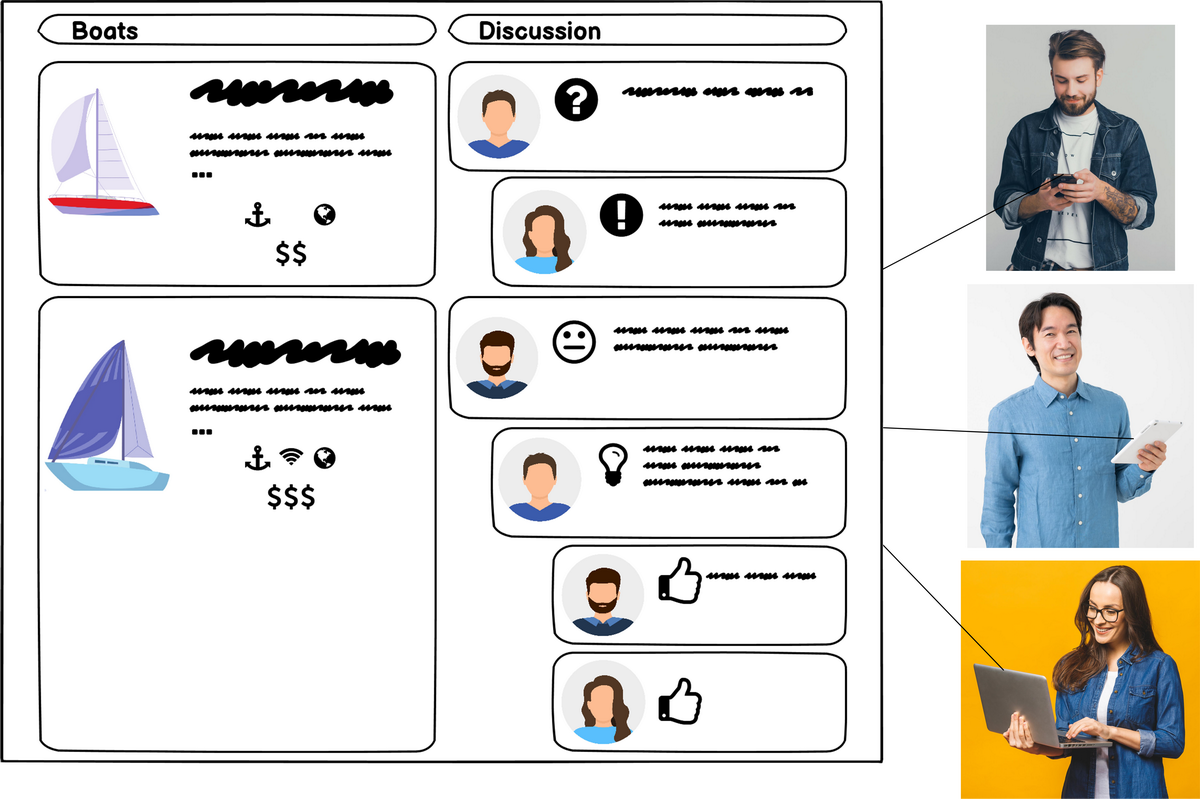
A possible hands-on exercise for this session is for each group to
(a) sketch a design idea for their chosen interface (with pencil and
paper or some available drawing tool), (b) get feedback from the
available “potential users”, and (c) draw conclusions
about necessary interface improvements.
- Summative Evaluation
In many projects, some sort of final evaluation is required that
reveals the extent to which the system that has been developed meets
the previously formulated functional and usability goals. Since it
would be infeasible in a hands-on session to conduct even a small part
of such a study, the hands-on work will concern the design of
such a study, including questions such as the setting in which the
evaluation is to be conducted, the dependent variables that are to be
captured, and the type of methods to be used for the analysis of the
results.