
AI applications in mobile communications and medicine – Rhineland-Palatinate provides €1.7 million in funding
| Health & Medicine | Industry 4.0 | IT Security | Machine Learning & Deep Learning | Sensors & Networks | Intelligent Networks | Smart Data & Knowledge Services | Kaiserslautern | Press release
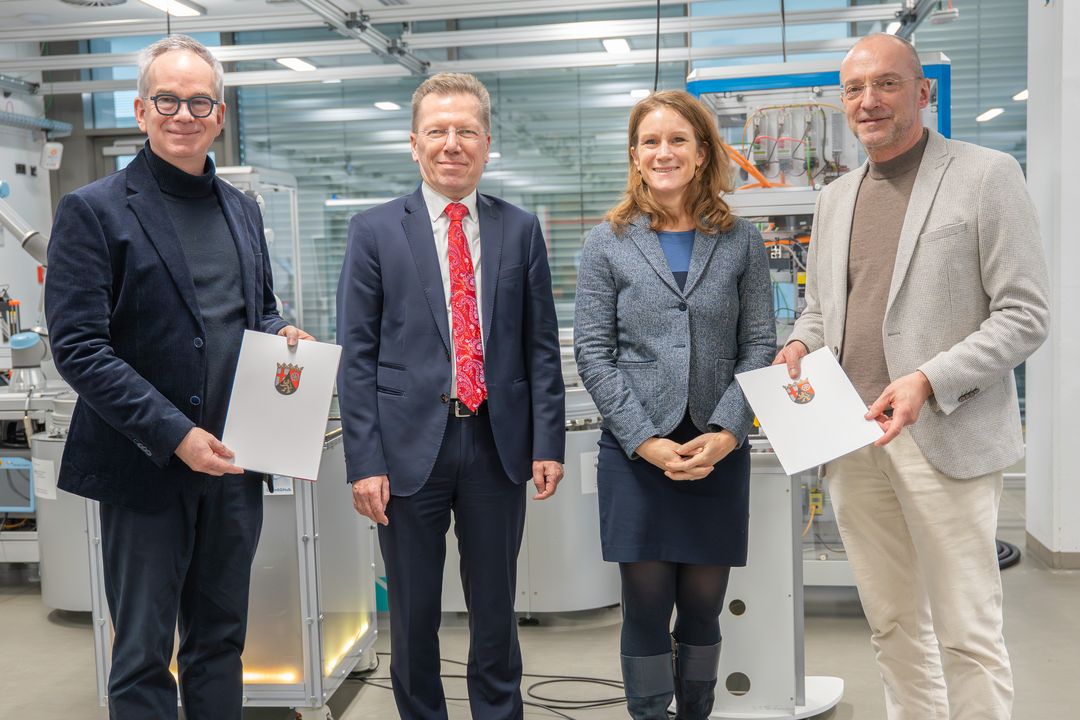
The Mainline-6G project, which is receiving €1.2 million in funding, is laying the groundwork for high-performance, future-proof communication. With the BIOMAX project, DFKI is taking an important step toward the holistic and transparent application of AI in the treatment of one of the most common causes of death: cardiovascular disease. Genetic and molecular biological findings are being combined with clinical data to develop novel AI models. The state is providing DFKI with €500,000 in funding for this project.
"The Rhineland-Palatinate state government is specifically focused on promoting cutting-edge research in forward-looking technology areas such as artificial intelligence. With DFKI in Kaiserslautern, we have an excellent research institution, dedicated scientists, and a strong innovation ecosystem in Rhineland-Palatinate. At the same time, we see great potential in artificial intelligence – scientifically, economically and, last but not least, for the benefit of citizens," said Katharina Heil, Ministerial Director at the Ministry of Science and Health. Digital sovereignty is a prerequisite for economic competitiveness, scientific progress and social trust in new technologies. Both funded projects would address these challenges in a special way.
Mainline-6G: Intelligent middleware as a key technology for secure and low-latency 6G networks
“With Mainline-6G, we are addressing a key technological foundation for the next generation of mobile communications: AI-based, agentic network services that enable highly reliable, real-time communications. This creates the conditions for secure and autonomous applications— from networked industrial processes and intelligent transportation systems to critical infrastructures. At the same time, we are strengthening Germany's digital sovereignty and innovative strength in the international 6G ecosystem.”
The Mainline-6G project is developing a central technological foundation for the 6G generation of mobile communications, which will connect everyday life, industry, and critical infrastructure even more closely in the future. The next generation of mobile communications will only function securely and reliably if artificial intelligence, data, and sensors work together in real time. This project is laying the technological foundations for precisely that. Mainline-6G focuses on the development of an intelligent communication platform in the future technology 6G. This new platform will enable autonomous vehicles, networked factories, digital twins, and smart city applications to communicate with each other in real time. In the long term, this can contribute to greater security, reliability, and efficiency in mobile communications by making 6G-based systems more resilient, autonomous, and trustworthy. Mainline-6G can also create significant added value for the economy by contributing to increased expertise, which can strengthen innovation potential. Thanks to close cooperation with existing 6G research laboratories in Kaiserslautern, the results are tested in practice and passed on.
BIOMAX: Explainable AI for identifying new biomarkers in cardiovascular research
"Cardiovascular diseases are the leading cause of death worldwide. With BIOMAX, we are developing explainable AI models that combine genetic, molecular biological, clinical, signal-based, and image-based data in a novel multimodal dataset. The aim is to identify robust biomarkers for various cardiovascular diseases, thereby enabling new approaches for earlier diagnosis and personalized therapy. In addition, the decision-making processes of the models should be understandable and verifiable – a key prerequisite for trustworthy AI in medicine."
The aim of the research project “BIOMAX – Explainable AI for the discovery of biomarkers in cardiovascular research” is to use artificial intelligence (AI) to identify new, reliable biomarkers that enable early diagnosis and more targeted treatment of cardiovascular diseases. Cardiovascular diseases are among the most common causes of death worldwide. BIOMAX therefore pursues an innovative approach: Researchers at DFKI combine genetic and molecular biological information, such as DNA, RNA, and proteins, with clinical data to develop novel AI models. These models are designed to recognize patterns across different data sources and identify robust, medically relevant biomarkers. Particular attention is paid to transparency and traceability. Explainable artificial intelligence (XAI) ensures that the decision-making processes of the models remain transparent and verifiable for science and medicine. BIOMAX strengthens Rhineland-Palatinate's role as a center of innovation for artificial intelligence and life sciences. The project is being implemented at DFKI in Kaiserslautern and ties in with the Mainz-based curATime future cluster, which is dedicated to personalized medicine in the field of cardiovascular diseases.
“With this funding, the Ministry of Science is sending a clear signal: research and innovation in the field of artificial intelligence are among the state's key topics for the future. At the same time, we are strengthening Kaiserslautern as a research location, creating impetus for innovation, and making an important contribution to the future of communication and medicine,” Katharina Heil concluded.
Press contact:
Christian Heyer
- Christian.Heyer@dfki.de
- Phone: +49 631 20575 1710