
Towards personalised medicine with AI
| Transfer Stories | Health & Medicine | Knowledge & Business Intelligence | Data Management & Analysis | Image Recognition & Understanding | Smart Data & Knowledge Services | Kaiserslautern | Press release
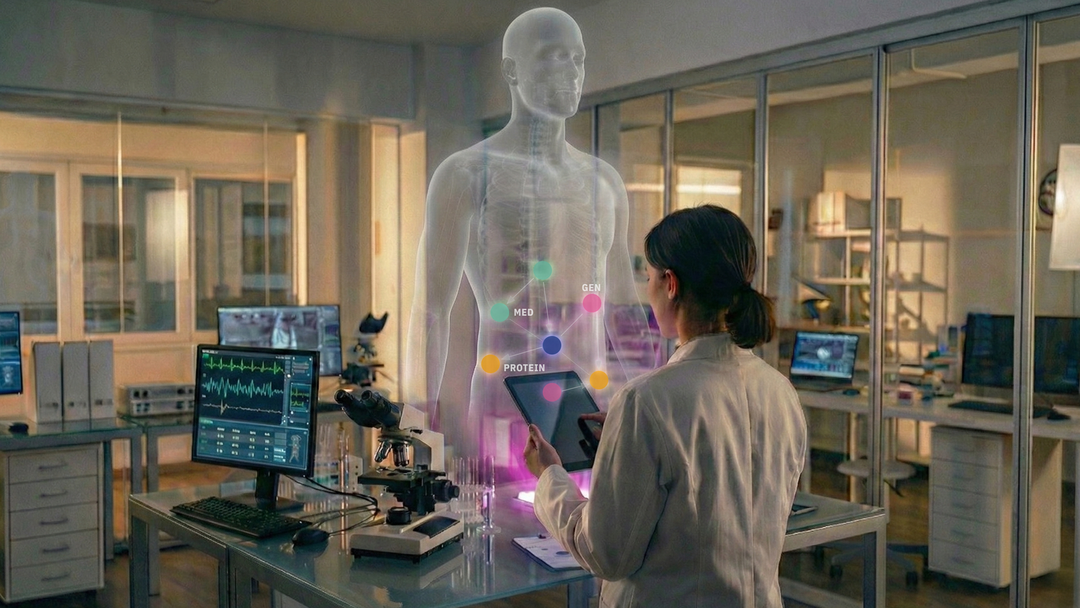
Our biomedical data is a complex puzzle made up of countless pieces of raw information in a wide variety of formats. This makes it difficult to maintain an overview. At DFKI, researchers are developing so-called knowledge graphs – huge networks that link genes, proteins, drugs and diseases, thereby providing new insights into hidden connections.
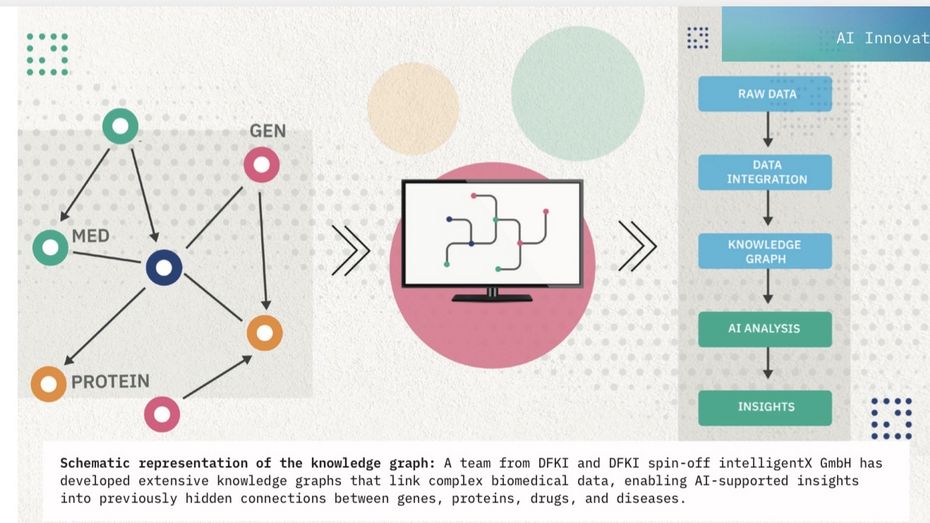
AI shows how a gene reacts to drugs or why a protein causes disease. Based on knowledge graphs, it recognises patterns in large data networks and provides clues as to how genes, proteins and drugs interact with each other. This insight helps doctors to plan and coordinate therapies and medication in a targeted manner.
Individual, highly specialised models perform specific tasks – from diagnostics to drug development. They analyse the data, validate their results and thus reveal which factors lead to a recommendation. This enables doctors, patients and pharmaceutical companies to review the results, compare them with their own assessments and make targeted adjustments to the algorithms.

Collaboration with industry – for rapid innovation
Scientists and medical professionals at DFKI work hand in hand to develop practical solutions quickly. Tailor-made prototypes are created in the transferlabs and tested directly against real-world challenges. This allows technological solutions to be tailored precisely to practical requirements. At the same time, young scientists gain deep insights into the application prospects of their research.
Ethical and regulatory challenges
The interplay between medicine and AI requires clarity and control. Ethical and legal aspects must be taken into account during the development stage. Sensitive patient data is anonymised and encrypted so that it is impossible to identify individuals. Scientists maintain a delicate balance between rapidly advancing innovation and maximum data protection.
Unclear regulations in the European AI Act are unsettling companies, slowing down investment and delaying the approval of AI medical devices. Research and practice are balancing between innovation dynamics and strict regulatory requirements.
Opportunities for personalised medicine
AI is already discovering novel biomarkers that enable therapies for rare diseases. The evaluation of extensive biomedical data makes drug development more efficient: precise predictions of effects minimise side effects, while medications are tailored to individual patients. DFKI is thus shaping a form of medicine that seamlessly combines research and care – responsible, accessible and forward-looking.
Contact:
Prof. Dr. Prof. h.c. Andreas Dengel
Head of Smart Data & Knowledge Services, DFKI Kaiserslautern
- Andreas.Dengel@dfki.de
- Phone: +49 631 20575 1000